


The working principle of the cooling fan is based on energy conversion, that is, electrical energy → electromagnetic energy → mechanical energy → kinetic energy. The circuit principle is generally divided into various forms. The performance of the fan will vary with the circuit adopted. Let's follow Xiao Bian today!
Speed: refers to the speed of fan rotation, which is usually measured by the number of revolutions in 1 minute, i.e. rpm. The rotational speed is related to the number of electromechanical winding turns, wire diameter, outer diameter and bottom diameter of fan blade impeller, blade shape and bearing used, etc. The air volume increases with the increase of rotational speed.
The speed value represents the air volume to a certain extent. Under certain conditions, the higher the speed is, the greater the noise and vibration will be. Therefore, low speed fans should be used as far as possible when the air volume meets the heat dissipation requirements. General speed (taking DC axial flow fan as an example): 2510 fan 7000~12000 rpm; 3010 fan 5000~9000rpm; 4010 fan 5000-7000rpm; 5010 fan 3500 ~ 5000rpm; 6025 fan 2600 ~ 4500rpm; 7025 fan 2400~3600rpm; 8025 fan 2000 ~ 3500rpm; 9225 fan 1600~3100rpm; 12025 fan 1500 ~ 2500rpm; 12038 fan 2000 ~ 3200rpm.
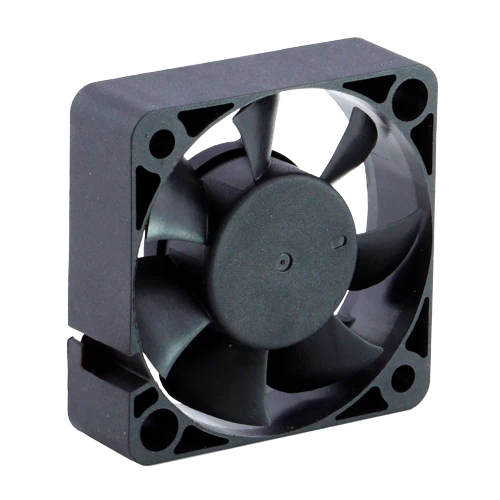
The fan speed can pass the BIOS test when starting the computer, or pass the monitoring software test of other motherboards; It can also be tested with a speed tester. Note: The first two methods can only be measured by fans that support the speed measurement function.
Air volume and pressure:
There are two methods for measuring air volume and air pressure. One is to use a wind tunnel instrument, and the other is to use the double-box method. But for ordinary users, there is no such device. The data provided by the manufacturer can only be used as a reference, and the cooling effect will ultimately depend on.
Air volume: air volume refers to the product of plane velocity of fan ventilation area. The ventilation area is the outlet area minus the projected area at the vortex tongue. Plane velocity is the velocity of gas flow through the whole plane, in m3/s. When the plane speed is constant, the larger the outer diameter of the fan impeller, the larger the ventilation area, and the larger the air volume. The plane speed is determined by the rotor speed and wind pressure. When the ventilation area is fixed, the greater the plane speed is, the greater the air volume is. The greater the air volume, the greater the heat absorption of the air. When the air flow is transferred, more heat can be taken away from the periphery, and the more obvious the fan heat effect.
Air pressure: in order to conduct normal ventilation, it is necessary to overcome the resistance within the ventilation stroke of the fan, and the fan must produce the pressure to overcome the air supply resistance. The measured pressure change value is called static pressure, that is, the differential pressure between the maximum static pressure and atmospheric pressure. It is the pressure of the gas acting parallel to the surface of the object, and the static pressure is measured through the hole perpendicular to the surface. The conversion of kinetic energy required in gas flow into pressure form is called dynamic pressure.
In order to achieve the purpose of air supply, static pressure and dynamic pressure are required. The total pressure is the algebraic sum of static pressure and dynamic pressure. The total pressure refers to the total pressure increase given by the fan, that is, the total pressure difference between the outlet and the inlet of the fan. In practical application, the nominal maximum air volume is not the air supply volume obtained from the actual fan heat exchanger. The large air volume does not represent the strong ventilation capacity. When air flows, the air flow will encounter the obstruction of fan heat patches or elements in its flow path, and its impedance will restrict the free flow of air. That is, when the air volume increases, the air pressure will decrease. Therefore, there must be an optimal operating point, that is, the intersection of the fan performance curve and the wind resistance curve. At the operating point, the slope of the fan characteristic curve is the smallest, and the change rate of the system characteristic curve is the lowest. Pay attention to the fan static efficiency (air volume × Wind pressure ÷ power consumption) is the best. Of course, sometimes in order to reduce the system impedance, even select a smaller fan to obtain the same air volume.


